

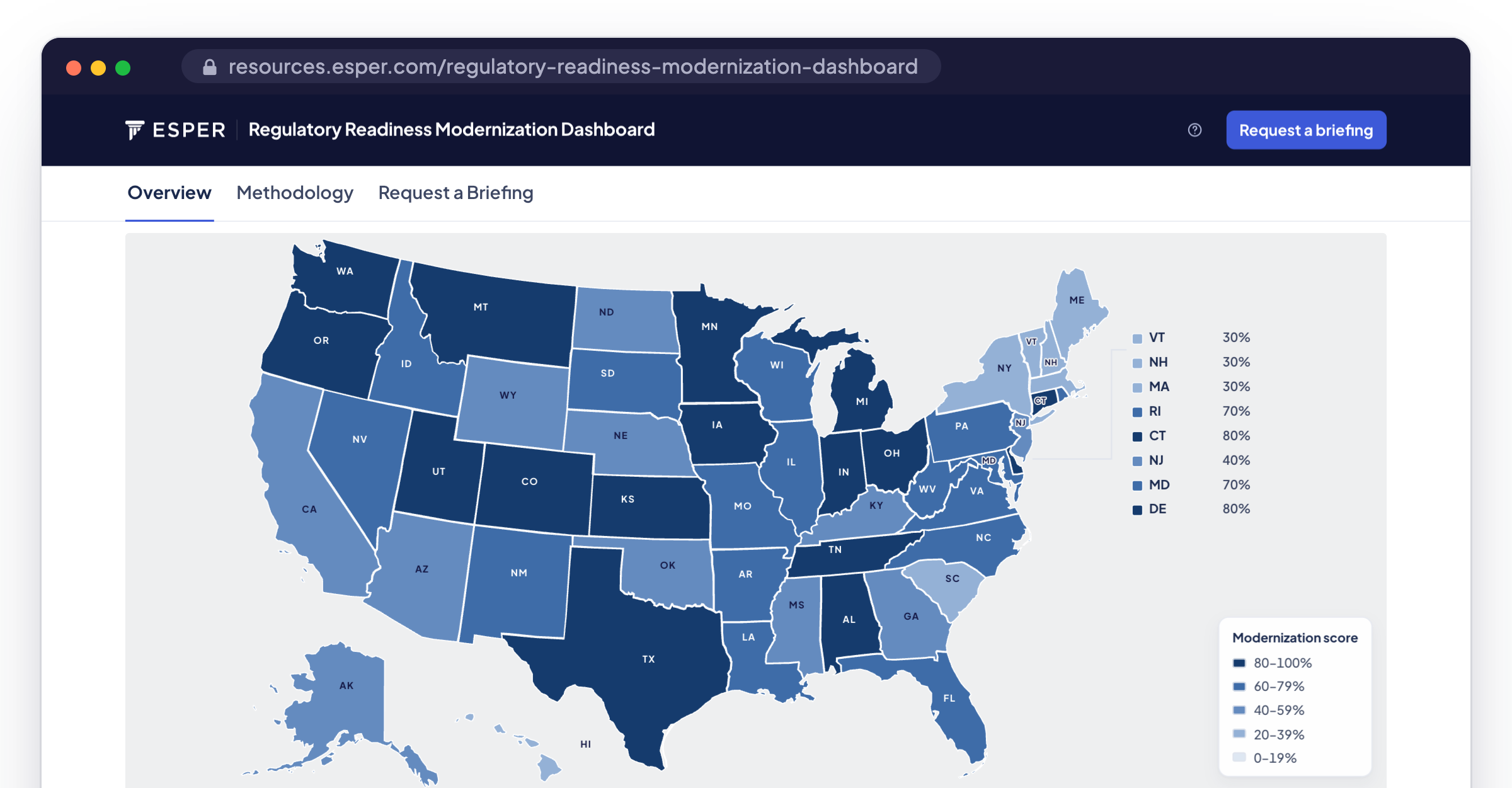

Every state is legally required to publish its administrative code in a place the public can find it. Decades ago, publication was largely a paper-based process, and citizens had to request a paper copy to read and understand regulations. Today, most people would assume that states have evolved past paper and made regulations easy to search and find for citizens. Esper’s recent 50 state regulatory modernization readiness report challenges this assumption.
States vary widely in how accessible, searchable and digital their regulations are for citizens. Many states still have books of the official administrative code housed in their office basements. Regulatory modernization is an increasingly high priority issue for states as governments work to boost economic growth and improve transparency. But the gap between a regulatory modernization promise and reality is larger than most state leaders realize.
We scored all fifty states' regulations on five factors: free access, keyword search, accessibility, statutory authentication, and whether the process still runs on paper. The result is a Regulatory Modernization Readiness Score. Only three states achieved a perfect score. The other forty-seven still have opportunities to improve their regulatory environment for citizens.
Where the accessibility deadline fits
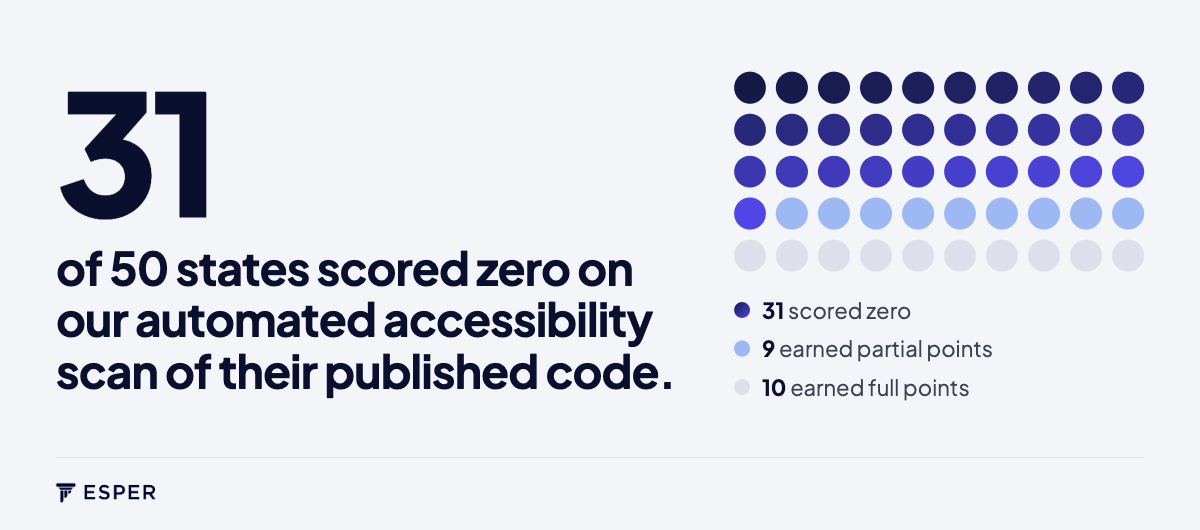
The April 26, 2027 deadline for WCAG 2.1 AA under DOJ's Title II rule is firmly on the calendar. Forty-four of the fifty states we scored haven't published a position on it, and based on our audits, twenty-nine states' published codes do not meet the federal standard today. The deadline is just one reason to act among several, and the case for modernizing how your state publishes its regulations will outlast it. The accessibility deadline makes now an opportune time to get started on regulatory modernization.
Accessibility is where modernization starts
Through our work with Secretaries of States, we’re seeing growing awareness and urgency around the upcoming federal accessibility deadline. This April 2027 Department of Justice regulation requires states to make their websites, including published regulations, usable by people with disabilities. That means someone using a screen reader or a keyboard instead of a mouse has to be able to find and read every rule.
This accessibility requirement is spurring states to take a closer look at how they publish regulations and what they can do to promote a more transparent, citizen-friendly regulatory environment.
Our Publication Profile scores every state on five factors, including an accessibility scan. Here's what each one means and where the states stand today.
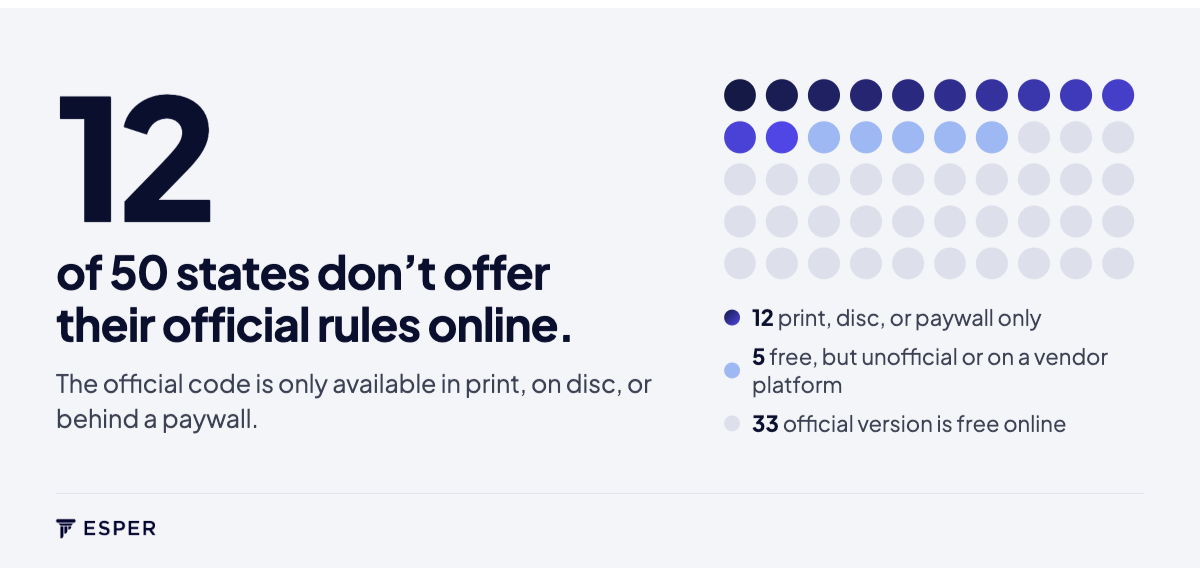
Free official access.
The official version of the code should be free for anyone to read online.
Keyword search.
People should be able to search the full text of the code by topic or phrase. Five states offer no search at all, and another twelve offer only limited search. While this may work for attorneys and agency staff who know every legal citation by heart, it leaves citizens and business owners without a practical way to understand which regulations may apply to them. Regulations exist to be followed, and a state without full-text search is asking its own residents to be experts on its own government.
Measured accessibility.
Published rules should meet WCAG 2.1 Level A and AA, the technical standard behind the DOJ regulation. The majority of states publish their regulations in PDFs and word documents, whereas the truly accessible standard is to publish regulations as web pages, that are more easily machine readable and accessible.
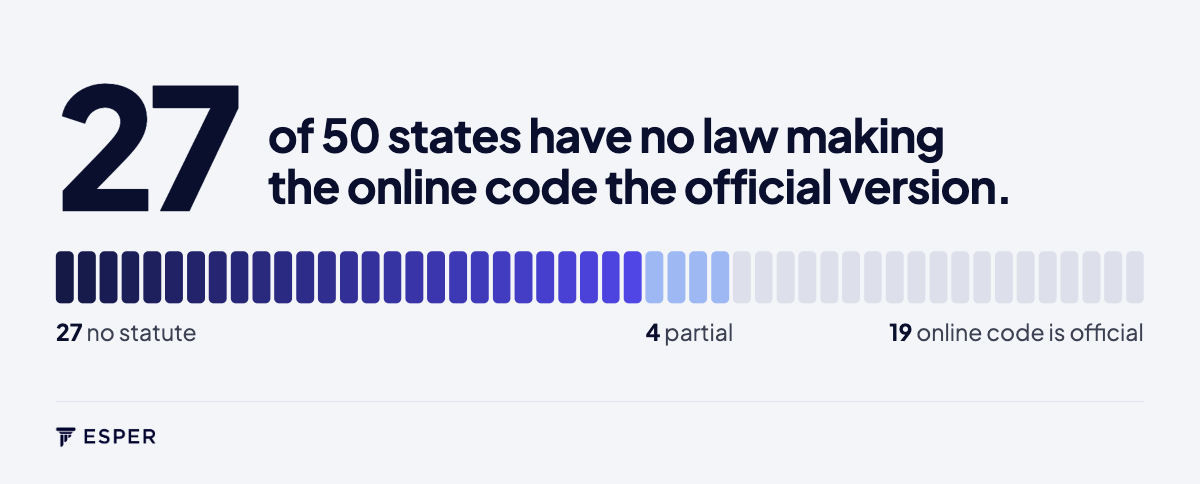
Official authentication.
State law should make the online version of the code legally official, so people can rely on what they find without requesting a certified copy.
This conforms to UELMA or the Uniform Electronic Legal Material Act, a model law that shows states how to authenticate official legal documents online.
Paper-free process.
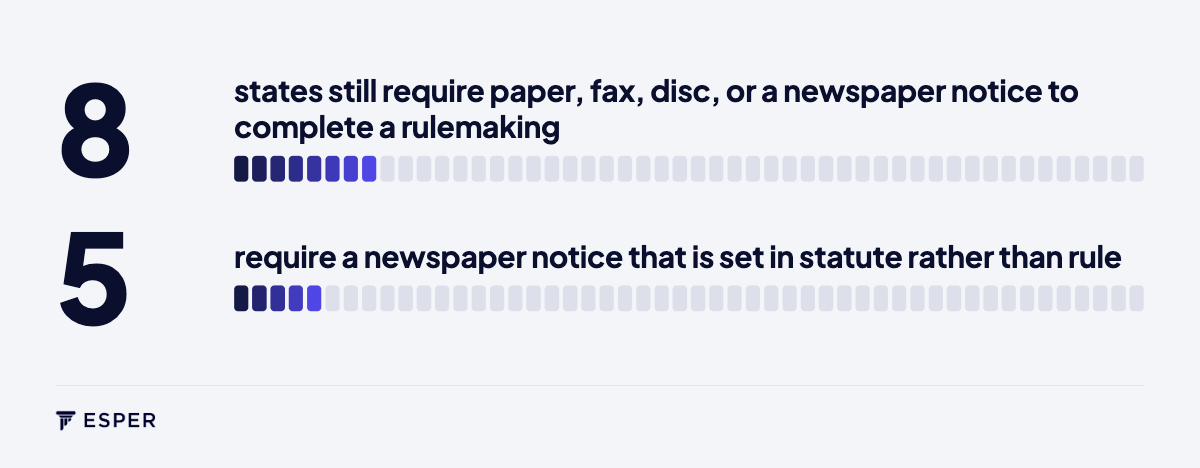
State agencies should be able to complete the regulatory process without paper copies, fax, disc, or wet signatures. Thirty-two states still rely on paper somewhere in how they publish or file their rules, and eight still require paper, fax, disc, or a newspaper notice to complete a rulemaking. Five of those require the newspaper notice specifically, which is set in statute rather than rule.
The gap to bridge isn’t that wide
Here's the part that tends to surprise leadership teams once they see their own score: most of what separates a fully modernized state from the rest isn't a new law. Three of the five factors we check (free access, search, and accessibility) are decisions your office can make directly without waiting on the legislature to pass or amend a law. In most cases, only two changes need a statute: authenticating the electronic version and removing a newspaper-notice mandate.
Modernization does not need to be a multi year legislative push. It's largely an operational decision your office is already positioned to make, and the case for making it writes itself once your own score is in front of you: here's where we already lead, here's the specific gap, and here's what closing it would take.
There's also a practical cost to waiting. Eighteen states require a formal review of existing agency rules, which keeps a steady stream of amendments, repeals, and readoptions moving through the register. Every one of them has to be published, and the more often the code changes, the more an outdated publishing process costs the office running it.
Kansas and Montana are modernization trailblazers
The Secretary of State offices in Kansas and Montana have already moved their full administrative codes onto public-facing platforms at rules.ks.gov and rules.mt.gov. Residents, businesses, and agency staff can search and read the current rules there without a login or a records request, and both states score at the top of the Regulatory Modernization Readiness Score.
These offices made the case internally without waiting for a federal deadline or statutory changes, and their sites offer a useful look at how other states have approached this work.
Find out where your state stands
We built the Regulatory Modernization Readiness Score to answer a question we’re hearing more often in state governments: how modern is our regulatory environment and what’s keeping us from achieving where we want to be?
If you don't know your state's score yet, take a look for yourself. Once you've seen where you stand, request a briefing and we'll go through what's already working and opportunities to improve regulatory modernization in your state.

.png)
.jpeg)

