



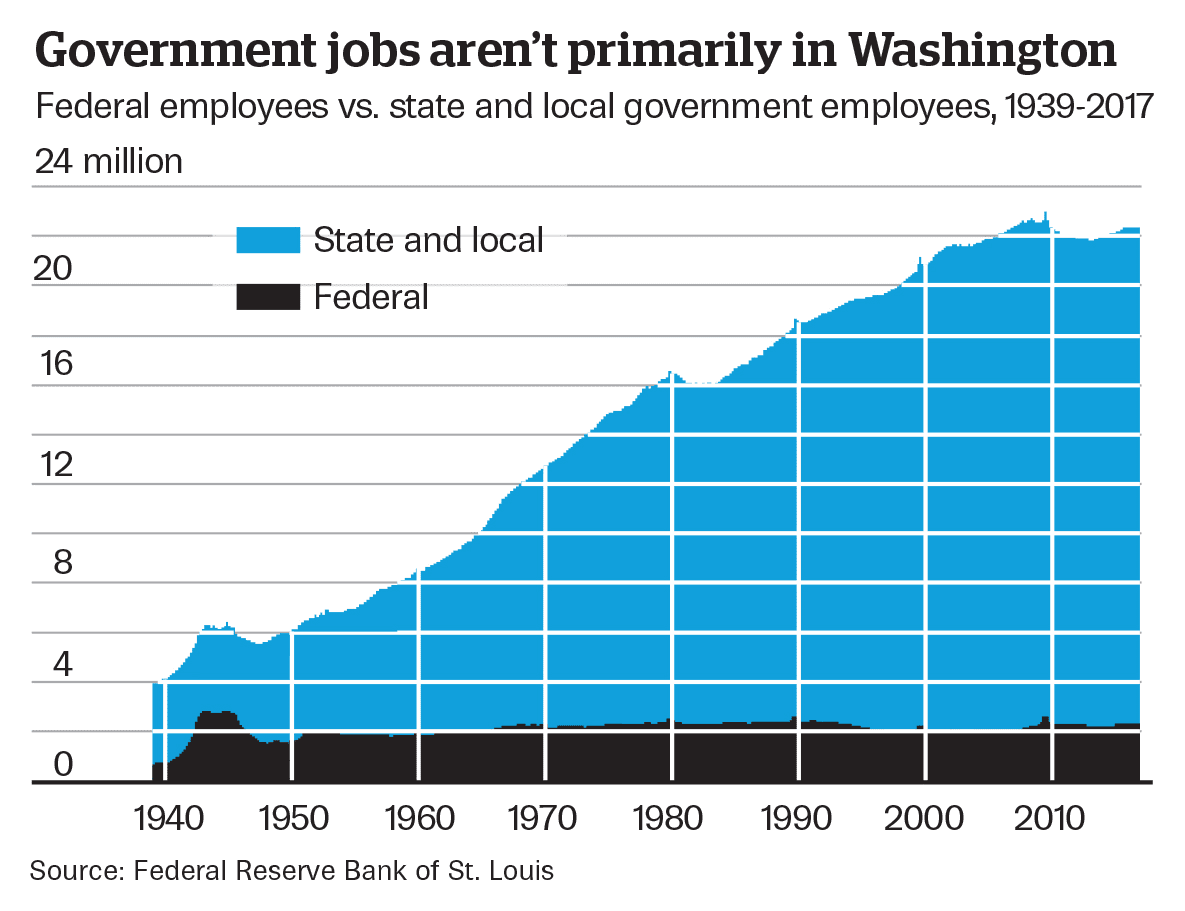
Did you know that the government is the largest employer in the United States? As of November 2018, an estimated 22.3 million people work for the U.S. government. For context, that’s nearly 10 times the 2.3 million employee count of the retail giant Wal-Mart. But these numbers are small in comparison to the United States’ quickly growing population, which adds nearly 3 million new citizens a year. As a result, the demand for efficient government services is steadily outpacing the availability of government resources. The needs of diverse communities put pressure on governments to update and enforce policies that reflect a growing and evolving culture. In order to keep up, governments need a technology infrastructure to deliver on their mission of delivering public good at scale.
Growing pains
As demand increases, the natural response of any public or private institution is to increase supply. Traditionally, governments have staffed up to meet increasing citizen needs. And, as the number and type of employees, goods, and services increased, government agencies developed complex organization charts reflecting contained divisions and teams. These teams are often grouped by specific issue areas and can easily become operationally independent of the agency as a whole, causing informational silos and piecemeal reporting solutions. As a result, it can be difficult to judge whether or not the entire organization is delivering on its mission.In addition to organizational complexity, administrative agencies often witness leadership and staffing turnover due to routine administrative change. This internal churn means lost institutional knowledge and reshuffling priorities every few years. In order to survive and thrive through change, efficient governments need a connective tissue to proactively address information gaps and procedural knowledge.
Scalable infrastructure
The challenge of coordinating large, complex administrations is undeniable, but there are solutions that can help agencies streamline internal knowledge and process. At Esper, we believe administrative efficiency can be solved with technology that increases knowledge sharing and internal accountability. Below are our recommendations for achieving administrative excellence at scale:
- Provide a common framework for understanding: The most productive teams operate from a single source of truth. It’s important for everyone to have a shared understanding and context in order to confidently execute on administrative priorities.
- Set and track goals: Effective large organizations systematically set and track individual, team, and organization level goals. Forecasting project successes and challenges is important to building a long-term plan for better policymaking. Governments should establish goals beyond the near-term and track their historical and current performance for internal review.
- Encourage cross-functional collaboration: Actionable insights and expertise exist throughout our governments but identifying and tapping those resources for full project success is difficult. Governments should adopt tools that enable collaboration while providing mechanisms for accountability and high fidelity information exchange.
- Embrace transparency: Some of the most important work in an efficient government never makes it to the public square. Whenever possible, government agencies should connect the public to information about the rulemaking process, like the state code, public meetings, policy goals, and year-end performance on the most important policy goals.
- Celebrate wins (and recognize losses): Internal and external recognition of successes and losses fosters a culture of ownership and success in public administration. For meaningful work to scale, even the smallest wins should be acknowledged.
If our governments, made up of millions of employees, are going to be effective for their hundreds of millions of citizens, then they must have a platform built for their work. Esper’s cloud-based platform makes scaling administrative processes possible. With Esper, governments can develop, track, manage, and analyze policies without the pitfalls of informational silos and knowledge gaps. In the face of an ever-growing citizenry with unique technological demands, our governments deserve a platform to support effective public policymaking at scale.


.png)

