


In the United States, public policy is the foundation on which business creation, growth, healthcare and economic development is built. The entire policy management process impacts citizens in almost all of their affairs—from occupational licenses to zoning requirements to travel restrictions. It is a critical part of how we live.
Oftentimes, the end result—the actual published policy—is what gets talked about the most. But, there is a lengthy process that precedes this—a process which is long overdue for innovation and technological advancement.
For former Commonwealth of Kentucky Chief Information Officer (CIO) and current Amazon Web Services (AWS) Executive Government Advisor Chuck Grindle, Ph.D., it’s a process he’s all too familiar with.
“During my time as the Chief Information Officer with the Commonwealth of Kentucky, our agency’s policy management process was laden with manual and non-productive procedures.”
Chuck Grindle, Ph.D. — Former Chief Information Officer, Commonwealth of Kentucky
This sentiment isn’t just unique to Grindle’s experience, though. It’s a collectively-shared challenge across local, state and federal government agencies.
Many agencies are still using legacy and on-prem infrastructure, printing out and circulating hard copies of policy and relying on manual processes for this crucial work. This way of policymaking has been working for decades, though. So, why change it?
In recent years, there have been monumental improvements in government technology (govtech). Companies are creating scalable and adaptive tools, software and infrastructure specifically for government agencies.
The goal of these technologies is to empower the government workforce with solutions to more effectively and efficiently conduct their work. There are several, easy-to-implement tech fixes to very common challenges in the government policymaking process.
“In the 21st Century, to require policymakers to be concerned about the formatting of content, instead of using a platform that can easily automate these tasks, is highly manpower-intensive and adds rudimentary time to an already very busy person.”
Understanding the stages of cloud adoption in the policy management process
There isn’t necessarily an “easy button” for cloud adoption. Oftentimes, it works in stages.
Many agencies are typically already in various degrees of cloud adoption in their policy management process. In our experience, we’ve observed four common stages of cloud adoption in policymaking:
As the CIO of the Commonwealth of Kentucky, one of Chuck Grindle’s strategic lines of effort was implementing enterprise-grade services. His goal was to discover applications that crossed boundaries—whether between agencies, departments or branches of government—and provide them holistically across the Commonwealth.
This resulted in the Commonwealth launching Esper state-wide to handle their policymaking efforts.
“In taking this approach and understanding the capabilities within Esper, we were quick to realize that the platform met our current requirements and offered so many desired elements related to workflows, security, collaboration and search. This allowed for a complete and final policy to be delivered in a consumable digital and, much to my chagrin, printed format if required.”
Obtaining stakeholder buy-in for cloud adoption in the policy management process
A shift into the cloud for agency policymaking requires buy-in from several stakeholders across multiple organizations—from General Counsels to policy drafters to agency directors to Secretaries of State.
“The biggest challenge in state governments is that while policies may originate within the agencies, they must be passed to the Legislative Research Commission en route to legislators. Having legislation start in the executive branch and then pass to the Legislative requires coordination and a willingness to work together.”
Esper took this into consideration when developing the platform, allowing for tailored access and configurable user permissions based on the individual. We understand that some stakeholders may draft, some may only review and some may just approve a final draft of a policy. This type of configurability is often lacking from private industry technology—that is technology not specifically built for government agencies.
It’s critical to position these different tools and feature-sets to stakeholders.
On an executive level, those individuals may only be interested in high-level data and progress. In Esper, dashboards are readily available for these stakeholders.
Policy drafters and collaborators would be more interested in the robust drafting, sharing and reviewing tool sets within Esper.
Another key to obtaining buy-in is to convey that purpose-built government software was crafted to empower agency staff and allow them to do their jobs more efficiently and free up valuable resources. SaaS platforms like Esper and cloud environments like AWS were created with governments in mind.
“While leadership may agree in principle, IT staff or other stakeholders, who are accustomed to doing things one way, may have a differing opinion. Therefore a lot of working together and coordination is required to be successful.”
The time is right for policymakers to move into the cloud
We keep repeating the phrase “purpose-built software.” We emphasize the uniqueness of our software because we’ve intentionally built technology with the government use case in mind.
In the State of Montana, the Montana Office of the Governor uses Esper to drive a state-wide regulatory relief initiative.
Understanding the specific challenges governments face is why partnering with govtech companies is so important.
Montana was dealing with the following roadblocks:
- Businesses were struggling in current regulatory landscape
- 13 state-wide agencies all have different processes
- No centralized location to review existing regulations
- No standardized workflows for rulemaking across state
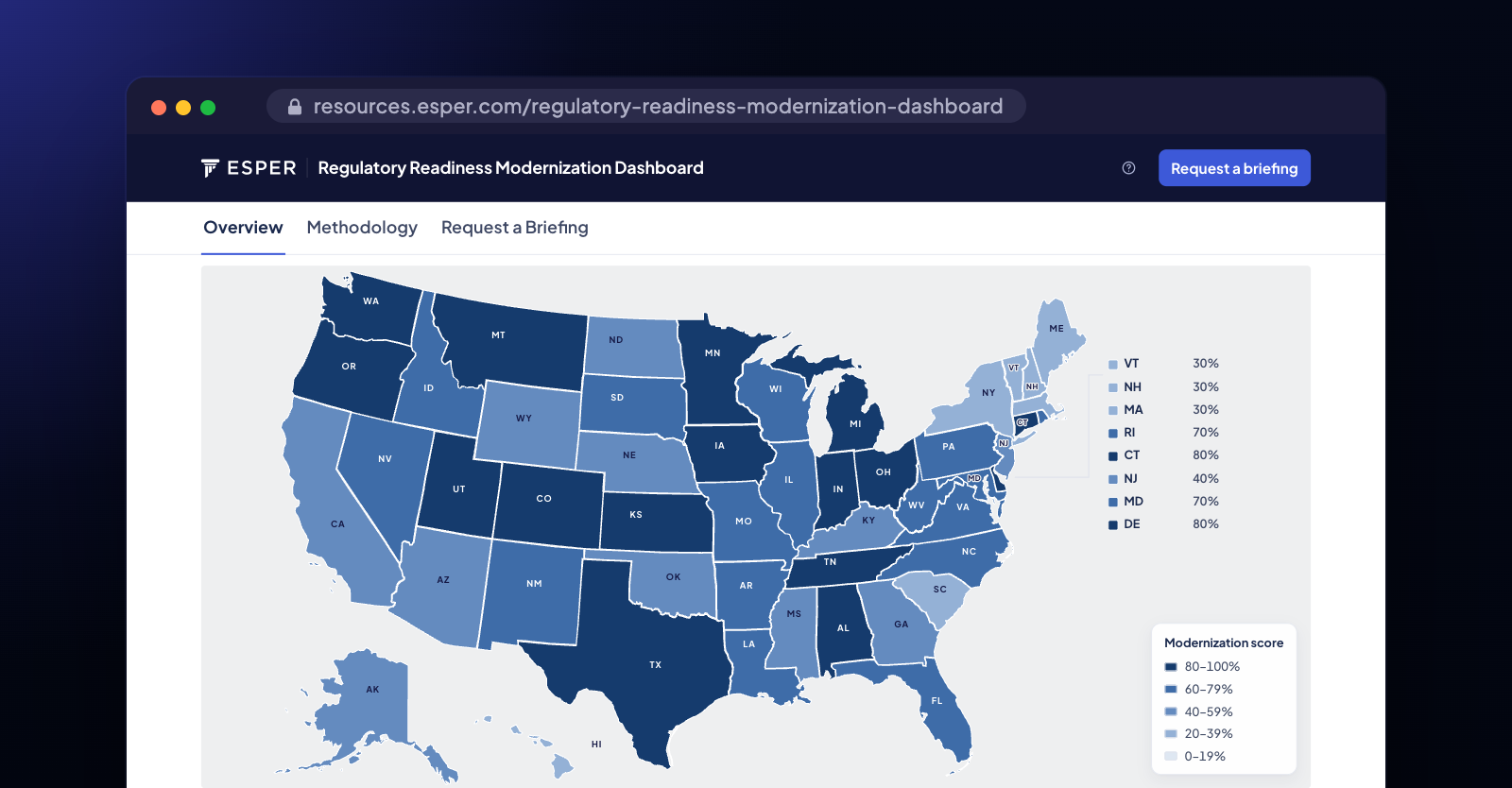
Esper partnered with Montana Governor Greg Gianforte and Lieutenant Governor Kristen Juras to tackle this issue head-on. The Montana Office of the Governor was able to leverage Esper's policy management solution to standardize and automate workflows for 13 state-wide agencies, search existing regulations to identify burdensome and outdated regulations, review flagged regulations to repeal or update and create state-wide transparency in the state's rulemakings.
“By thoroughly and carefully reviewing, rolling back and repealing unnecessary regulations, while also ensuring safeguards for public health and consumer safety, we will reduce the burden Montanans face and help more people thrive and prosper.”
Kristen Juras — Lieutenant Governor, State of Montana
COVID-19 has accelerated digitization across local, state and federal governments. Now, more than ever, trusted govtech partners are critical for scaling, adapting and responding to the unique challenges of today—as well as tomorrow.
We’re witnessing a drastic shift away from custom-coded software that took years and tens of millions of dollars to build, implement and maintain. SaaS offerings are becoming increasingly popular in the government landscape, as well as migrating on-prem infrastructure into cloud environments like AWS.
With procurement and contract vendors, the way SaaS products can be purchased has also drastically changed. The ability for governments to procure software through trusted vendors allows agencies to responsibly modernize—building out a solid foundation while mitigating risk. Esper’s addition to AWS Marketplace adds even more flexibility to governments looking to purchase software to help in the policy management process.
“AWS Marketplace allows state and local government and K-12 and higher education organizations with an AWS account to expeditiously acquire Marketplace products. Our partners place their services on Marketplace in a readily procurable manner which allows for the agency to purchase without the long drawn out process of traditional government and education procurement.”
Chuck Grindle, Ph.D. — Executive Government Advisor, AWS & Former CIO, Kentucky
Think big, start small and move fast
These types of changes can seem massive—and do not happen overnight. Grindle’s experience at the Commonwealth of Kentucky and with AWS has taught him, what he feels, is a winning formula for driving a cloud-first policy management process.
“A colleague uses the motto: Think Big, Start Small and Move Fast. When you think about these three items, “Thinking Big” allows you to eliminate all the blockers that may handcuff a project like changing a policymaking platform. “Starting Small” with one agency or one policy that touches a couple of agencies will allow for the proper testing and buy-in of the system. Then you "Move Fast.” Once you have proven the concept and things work as planned, repeating the rollout as quickly as you can is imperative. Time ruins all new implementations, so the speed you can complete the task list will ensure a successful project.”
To learn more about Esper’s policy platform, schedule some time with one of our government experts.


.png)

