

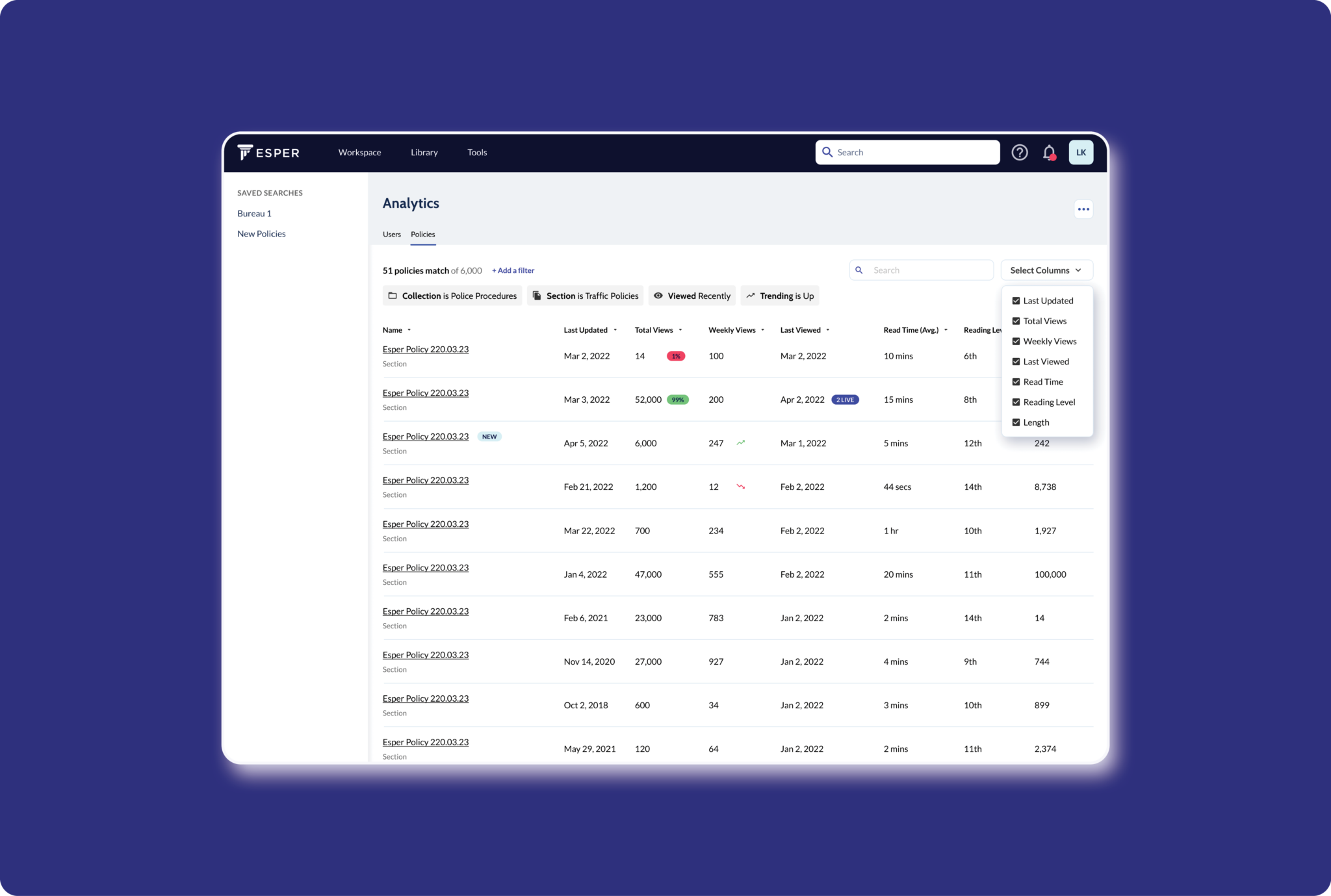

Esper, a leading provider of public policy software, is pleased to announce our brand new toolset that allows government agencies to manage their non-regulatory policy documents. This new product capability enables governments to ingest internal policy documents and templates, collaborate on and draft non-regulatory policy and publish those policies directly to Esper—allowing for agency staff to access them on desktop and mobile devices.
This much-requested expansion of Esper’s capabilities allows customers to create a system of record for all policy, whether regulations or employee handbooks.
Creating a holistic approach to policymaking with Esper's public policy software
Many of Esper’s clients currently use our public policy software to manage their start-to-finish rulemaking processes. Regulatory management was a challenge that Esper solved by automating highly manual processes and consolidating multiple pieces of software into a single solution. After customers realized success with Esper’s regulatory solution, they began asking for ways to manage other policy types within their agency—whether it be IT protocols or internal memos. Customers were struggling to contain these policies with out-dated and labor-intensive processes.
A majority of agencies are using a combination of manual processes (email chains, printing policies, etc.) and multiple technologies (Word, Sharepoint, Westlaw, Monday, etc.) to manage all of their non-regulatory policies. This had led to issues with version control, collaboration, policy review and missing key deadlines.
Esper took all of this into consideration when developing these new product capabilities.
Government agencies are now able to use Esper’s public policy software to handle all of their policy creation, automate all policy workflows and approvals, research existing state and federal regulations and visualize key due dates in ongoing policy projects.
A snapshot of what governments can accomplish with our new internal policy tool
- Create a source of truth for all policy documents
- Make intuitive references to associated policies and documents
- Store and track previous versions of policies
- Create or update policies by drafting directly in Esper
- Establish standardized policy templates
- Share policy documents for editing, review or approval with internal stakeholders
- Export finalized policy documents or publish directly to Esper
- Track stakeholder engagement with finalized policies
Launching with the New York City Police Department
Esper’s first client to leverage these new product capabilities will be the New York City Police Department (NYPD). The NYPD maintains a procedural manual in excess of 3,000 pages—which requires continual updating by the department.
NYPD will be using Esper's public policy software to draft and review policy and route it for approval, publish new and updated policies to their 50,000+ employees, track the engagement on their policies and maintain historical records of previous versions of policy.
With many officers out in the field, NYPD also needed their policies to be accessible via mobile device. Esper allows the NYPD to not only publish standard desktop versions of their policies, but mobile-responsive versions for access out on the road.
How does implementing this work?
Esper starts each client onboarding by conducting a deep-dive into internal policy processes with our government partners. This is handled by our Professional Services team, who will work closely to outline all of the business requirements for a given policy and automate these into a templated workflow.
Agency staff are able to choose their desired workflow. For example, if an agency is working on a new Guidance Document they would choose the Guidance Document workflow that is prepopulated with all of the necessary document templates, due dates and approval processes. These templates are uploaded to the system prior to launch by our Professional Services team, but the ability to add additional documents is available to agency staff once Esper's public policy software is launched.
Building an ecosystem within our public policy software
This strategic addition to Esper’s suite of policy workflow and management tools will allow agencies to keep all policy under one digital roof. Our purpose-built public policy software is continually improved upon to tackle the unique challenges inherent in government policymaking. With more robust product capabilities on the horizon, Esper plans to continue building upon the leading public policy software on the market.
To see the Policy Library in action, please schedule some time with one of our government experts.


.png)

