



The process for creating and enacting public policy in government is part art, part science. It requires pulling together internal and external stakeholders to gather data, draft policy, and eventually reach a decision that is in the best interest of the public. This is why project management in government is such a critical component of the policymaking lifecycle.
While many people might be familiar with the Ways & Means Committee in Congress, which establishes the process for which bills are heard, there is less insight into how regulation is crafted in executive branch agencies.
Every state and the federal government has a slightly different process for conducting administrative rulemaking, and each jurisdiction often has its own version of the Administrative Procedures Act that mandates specific legal requirements in order for a rulemaking to hold statutory ground.
Some states even go as far as establishing third-party oversight bodies to make sure rulemakings are conducted with appropriate data analysis and public feedback, like the Common Sense Initiative in Ohio and Governor’s Regulatory Review Council in Arizona.
Organizations at the federal level, like the Office of Management and Budget (OMB) and the Office of Information and Regulatory Affairs (OIRA) have the power to take this oversight a step further and drive how regulatory processes engage with stakeholders.
OIRA & OMB: Silent Regulatory Engines
You can think of OMB and OIRA as the hardware that processes and manages all of the regulatory “code” developed by agencies. Therefore, a change in OMB policy or OIRA activity can rewrite how executive agencies conduct rulemaking.
In fact, the OMB recently prescribed significant changes to the federal regulatory process and subsequent workflows. Federal agencies are now required to provide OIRA with designations of “minor” or “major” for proposed rules or guidance and major rules will have to be submitted to Congress for review and voting. The directive also applies to independent agencies, which are usually exempt from regulatory reporting to OIRA and OMB.
Agencies will struggle to keep up with evolving regulatory norms if they do not fully operationalize the tools, data, and labor they need to execute their mission. New technologies are charting a path towards true regulatory management with end-to-end processing from regulatory drafting to analysis and review.
Why is the OMB changing things?
The federal rulemaking process is a long, arduous process that has become increasingly complex in recent years. For context, this timeline illustrates the changes in the regulatory process over the past sixty years. Here’s a quick look at a simplified process:
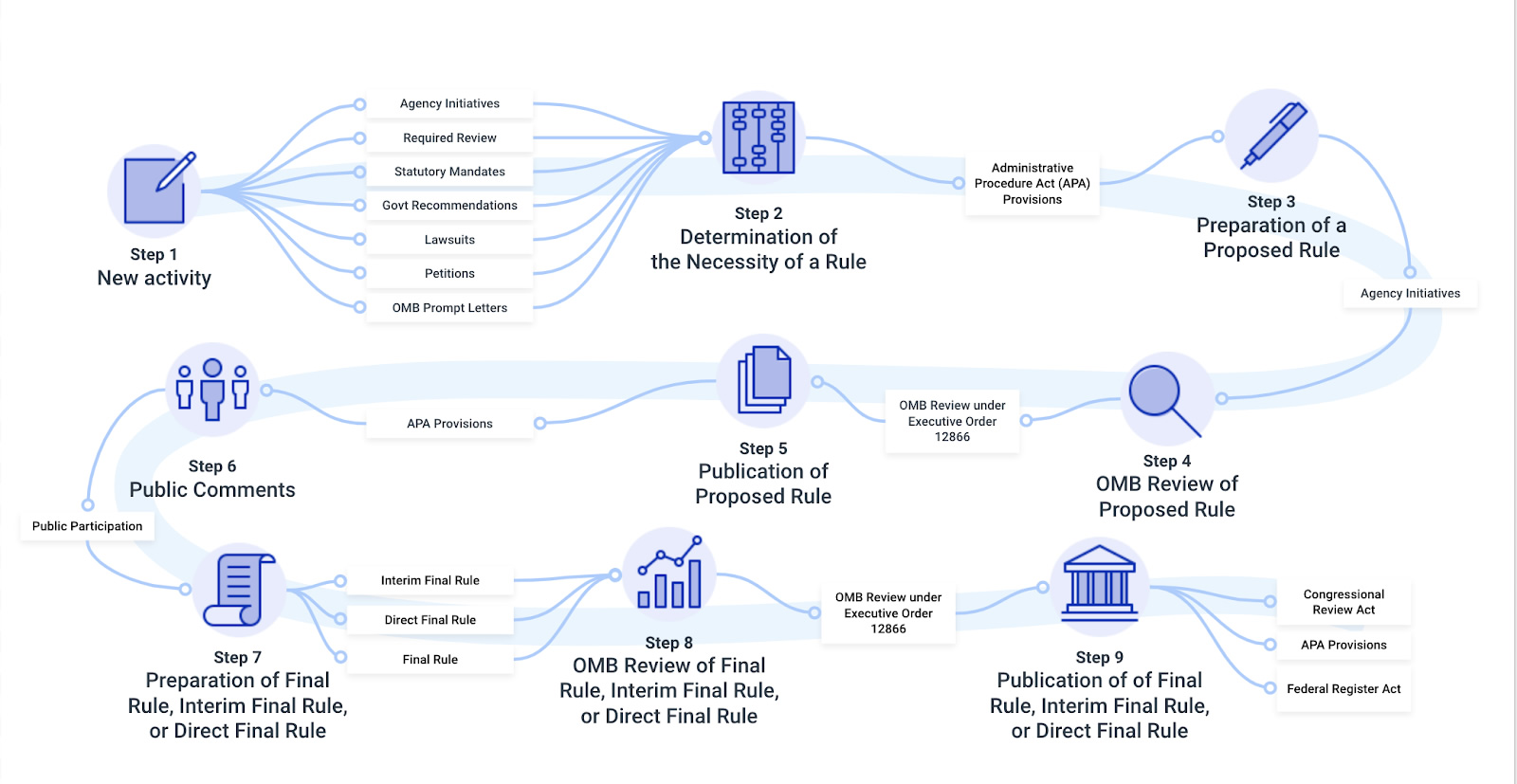
Without project management in government or internal infrastructure tools in place to guide this complex process, rulemakings can take months (even years) to complete and often lack the transparency and attention they deserve from internal and external stakeholders.
Esper is the regulatory system of record
Esper is helping governments tackle the challenges of regulatory management and review with our Policy Management System. We add operational visibility into the regulatory process and scalable workflow tools for administrative agencies.
Our platform has been deployed to simplify the drafting, review, management, and storage of policies for governments. Now, governments have enterprise-grade tools to accomplish their mission of rulemaking for the public interest.
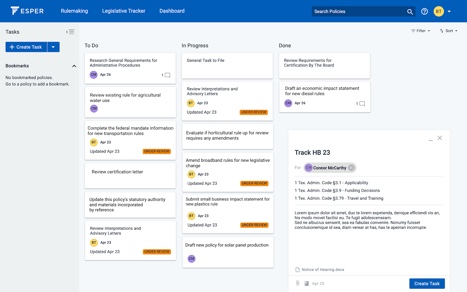
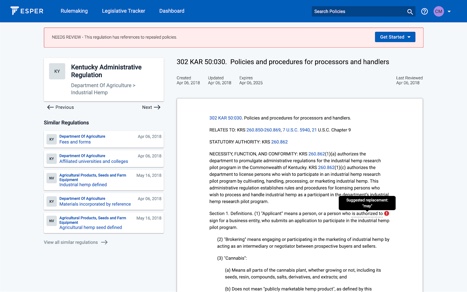
Esper’s Policy Management System is a software platform that delivers the tools and capabilities that regulators need. Our government partners are thriving on tools purposefully built to solve their unique workflow needs. Interested in learning more about how we’re powering regulatory process? Get in touch!
ABOUT ESPER
Esper is a cloud-based technology platform that provides data analysis and workflow tools to manage the policymaking process in government. Our clients include state and federal government agencies. Esper is based in Austin, TX.


.png)

